Alabama Court Case Search: Find Your Lawsuit Fast
Alabama does not offer free online court record searches. You can search for your case on Just One Look for $9.99 or visit your local courthouse for free. Once you find your lawsuit, respond immediately to avoid a default judgment that could result in wage garnishment or bank levies.
Answer Your LawsuitAre you wondering if a debt collector has sued you in Alabama? Did you receive a summons? Maybe you need to track a previous court case.
Good news: Alabama court records are generally public unless stated otherwise.
Found Your Alabama Lawsuit? Respond Before the Deadline
You have only 14 days to respond to a District Court lawsuit in Alabama. Missing this deadline means automatic loss. Answer your lawsuit now and avoid wage garnishment.
Respond to Lawsuit NowYou should have all case details without searching, right? Ideally, yes. But real life gets complicated. Maybe the summons was delivered to the wrong address. Perhaps they served someone else in your household. Or you received the court papers but felt too stressed to deal with them immediately.
By the time you face the issue, the hearing date has passed. Panic sets in.
You need to check your case status. Here is everything you need to know about finding your Alabama lawsuit, checking case status, and responding properly.
Understanding Alabama’s Civil Court Structure
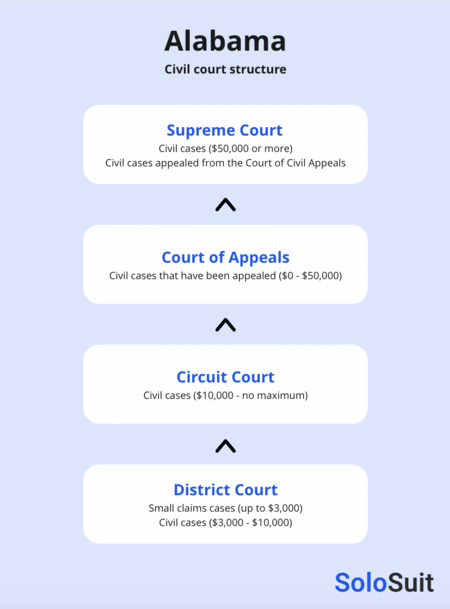
Alabama has four levels of courts handling civil cases. Knowing which court has jurisdiction helps you narrow down where your case lives.
Supreme Court
Handles appealed cases involving $50,000 or more.
Court of Civil Appeals
Deals with appealed cases ranging from $0 to $50,000.
Circuit Court
Has jurisdiction over civil cases involving $10,000 or more. You have 30 days to file your answer in Circuit Court.
District Court
Your debt collection lawsuit likely starts here. District Courts have exclusive jurisdiction over small claims up to $3,000. They also hear civil claims up to $10,000. Alabama has 67 district courts, one for each county. You have 14 days to respond in District Court.
How Alabama Courts Assign Case Numbers
Every court case gets a unique number. You can quickly access documents, motions, judgments, and other activities with that number.
The letters at the beginning tell you what type of court filed your case:
- SM (Small Claims Court): 14 days to respond from service date
- DV (District Court): 14 days to respond
- CV (Circuit Court): 30 days to file your answer
A court number combines numbers and letters identifying the lawsuit type and filing time. For example, DV-2022-900000.00 is the 900,000th District Court case filed in 2022.
If you lose the case number, you can search online using your name. Alabama court access charges $9.99 for a search. Monitoring the case throughout its duration costs $19.99 for district cases and $29.99 for circuit cases.
Why You Must Find Your Lawsuit Immediately
Never ignore a lawsuit. Pretending it does not exist makes everything worse.
The judge may issue a default judgment against you. You could suffer wage garnishment, frozen bank accounts, or property liens. A judgment lien attaches to your Alabama property for ten years, whether you sell or keep it.
After a judgment, you cannot dispute errors. Even if the debt was a mistake, you lose your chance to fight. Our partner Solo can help you respond before that happens.
You have two main options to find your lawsuit:
- Check online
- Visit the courthouse or call the court clerk
Check Your Alabama Court Case Status Online
Alabama does not offer free online court record searches. Other states provide free tools, but Alabama requires payment.
Use Just One Look: Access To Alabama State Trial Court Records to search for civil and small claims cases online.
Searching by name or case number costs $9.99. You get access to a case detail report including:
- Basic case information
- Court action
- Case status
- Setting dates
- Party information
- Financial history
- Detailed case action summary
Downloading court record images costs $5.00 for the first 20 pages. Each additional page costs $0.50.
Just One Look also provides access to criminal records, state traffic records, domestic relations cases, and child support cases.
Check Your Alabama Court Case at the Courthouse
You can get case details from the court clerk. Call the court or visit their office. Most clerks will help if you provide case information: case number, party names, or other details.
The option works well if you know where your case was filed. Even if you only suspect a case exists, the clerk can confirm or deny it. You will learn the plaintiff’s name, why they are suing, and important case dates.
Use this Alabama Courts Directory to find your courthouse. Click on your county and your court website opens. You will find the courthouse address and clerk contact information.
Check Federal Court Case Status Online
The US Courts website offers Public Access to Court Electronic Records (PACER). It provides electronic records of public federal cases.
You need to create an account to use PACER. Once registered, you can find any public case with a simple search. Log in and use your preferred method to find public details. Search in the federal court where it was filed or use the nationwide index.
PACER costs ten cents per page to view court documents. The cost of a single document is capped at $3. The website includes a user-friendly guide to finding cases without the case number.
Visit judicial.alabama.gov, pa.alacourt.gov, or justice.gov for Alabama cases. Check each site for terms of use and applicable charges.
Some privately owned websites also offer court record searches. Use discretion when entering your information into these sites.
What to Do After You Find Your Lawsuit
Respond immediately once you confirm someone is suing you. Even if court proceedings started without you, you might still defend yourself. Courts allow for permissible negligence like summons sent to wrong addresses. Identity theft is another valid defense.
If you find your case in good time, do not waste it. You must file an answer to the lawsuit. Our partner Solo helps you prepare a legal answer document that courts accept.
Answer simple questions to create your personalized answer in minutes. You can print and mail your answer yourself. Or you can pay an affordable fee to have the answer filed for you with attorney review included.
After you file your answer, explore other options to fight debt collectors. You can file a motion to compel arbitration to avoid going to court. You can reach out to settle your debt for less before the court date. Both options help you stay away from the courtroom, which can be intimidating and stressful.
You can quickly find present, scheduled, and past cases by checking online or visiting your court clerk. Remember to respond promptly to avoid losing by default.
Next Steps to Fight Your Alabama Debt Lawsuit
Finding your lawsuit is just the first step. You must respond within the deadline. In Alabama District Court, you have only 14 days. In Circuit Court, you have 30 days.
Missing this deadline results in a default judgment. The debt collector wins automatically. They can garnish your wages, freeze your bank accounts, and place liens on your property.
Do not let that happen. You have the power to fight back. You can challenge the debt, question the evidence, and negotiate a settlement. You just need to respond on time.